
Business Optimization & Digital Solutions
Streamline your organization, drive efficiency and unlock growth through smart operations
In today’s competitive landscape, businesses that modernize their operations gain a significant edge—eliminating inefficiencies that drain resources and slow growth while positioning themselves for sustainable success.
Businesses often face inefficiencies that slow them down—whether it’s a specific bottleneck, an outdated workflow, or the need to rethink operations of an entire function. The right processes and technology strategy – centered around people – can drive efficiency, and enable scalable growth.
What is Business Optimization?
Business optimization involves making workflows ‘smarter’ and more efficient using technology and data.
AI is transforming workflows by automating tasks, improving personalization, predicting and enabling smarter decision-making. Outside of that, a lack of integration or employee awareness and training can prevent a business from operating efficiently.
5 reasons to invest in smart operations
Businesses that delay optimization and AI adoption risk falling behind more agile competitors who are already leveraging technology to drive efficiency and growth.

1. Manual Processes:
Slow, outdated workflows lead to delays, errors, and unnecessary costs, with studies showing that manual processes can consume up to 60% of an employee’s workday.1

2. Disconnected Systems & Data Silos:
Lack of integration between systems results in inefficiencies and missed insights, forcing teams to spend valuable time reconciling information rather than acting on it.
3. Technology Overload:
The rapid evolution of technology, including AI, makes it difficult to choose the right tools and platforms that will meet needs and budget, while supporting long-term goals.

4. ERP Complexity & Change Resistance:
Selecting and implementing an ERP system can be overwhelming without the right support. Many ERP systems are rapidly adding functionalities, with underutilized platforms costing companies $104 million in 2024 alone.2

5. Uncertainty on Where to Start:
Companies know they need to improve certain workflows, but lack a clear roadmap to drive meaningful change, delaying optimization and missing opportunities for competitive advantage.
How we’ve helped clients
Problem 1: Reporting – Inaccuracies, fragmented data and lack of KPI visibility
Solution: Workflow technology solutions can provide streamlined data collection, analysis, and integrated reporting, providing real-time insights into business performance.
Problem 2: Invoicing – Data errors, delayed processing and difficulty tracking invoices
Solution: Automation can capture invoice data, match it with purchase orders, and automate the approval and payment process, reducing errors and speeding up processing.
Problem 3: Customer Service Management – Long response times and lack of personalization
Solution: Automation can handle routine inquiries, personalize interactions, and provide 24/7 support, freeing up agents for more complex issues.
Problem 4: Inventory Management – Poor visibility and difficulty tracking inventory levels
Solution: Automation can track inventory in real-time, predict demand, and optimize stock levels, reducing waste and improving efficiency.
Our approach
Kaufman Rossin helps businesses identify, prioritize, and implement operational improvements and technology solutions that deliver measurable business impact and sustainable results.
We focus on meaningful business outcomes over adopting technology for its own sake. From process assessment to implementation, we provide a seamless approach to help drive adoption, alignment within your organization and long-term success.
Workflow & System Optimization
Drive efficiency, reduce manual effort, and scale smarter with optimized processes and the right technology. We take a holistic approach to uncover inefficiencies and implement tailored solutions that streamline operations and support growth.
Our workflow and technology optimization services include:
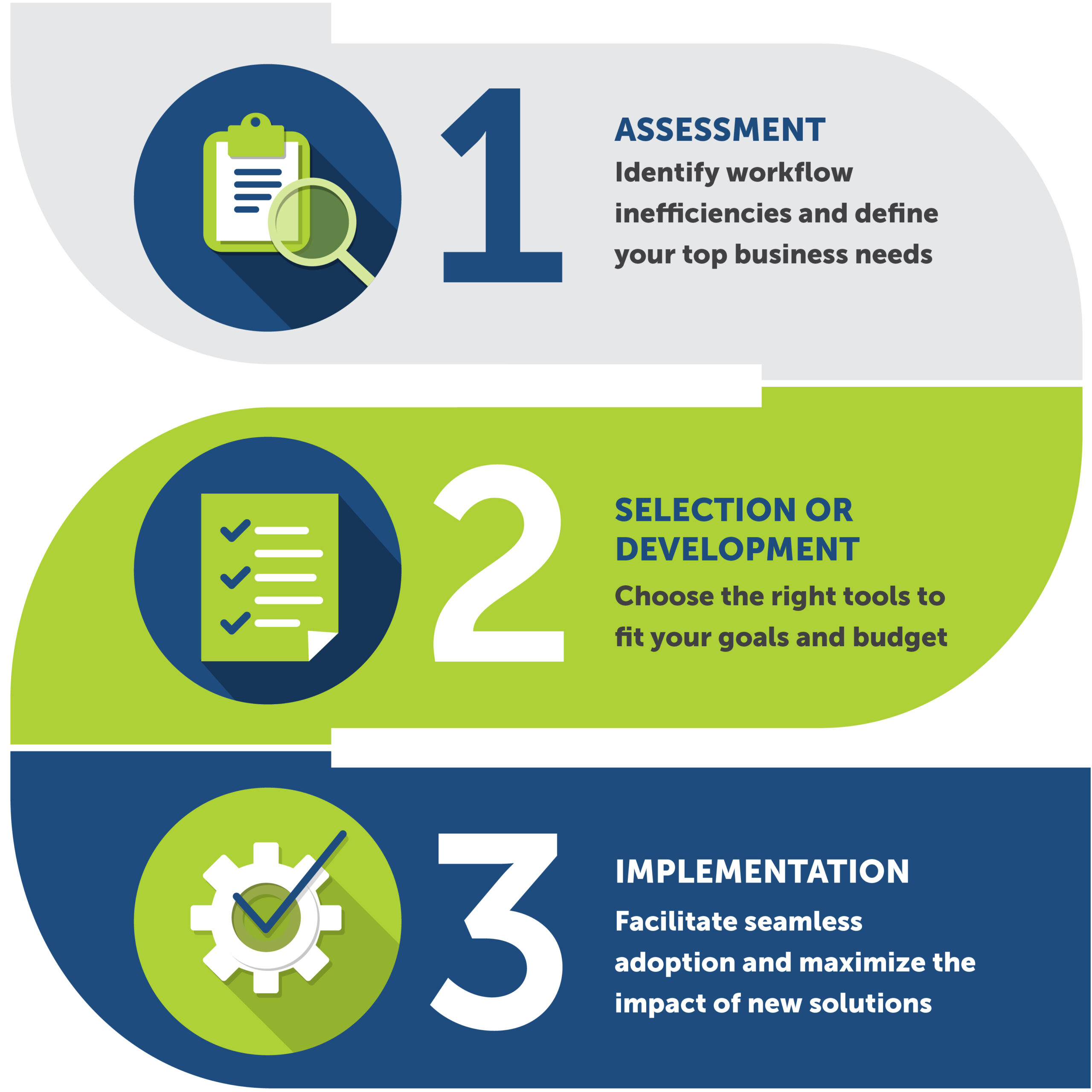
- Assessment: We start by analyzing your existing processes to identify pain points, inefficiencies, and opportunities for improvement—then align those insights with your most critical business goals.
- Tool Selection or Custom Development: Whether it’s selecting off-the-shelf tools or building custom solutions, we help you find the best-fit technologies to meet your operational needs, scale with your business, and stay within budget.
- Implementation & Adoption: From rollout to user training, we ensure new tools are integrated seamlessly into your workflows. Our focus is on maximizing impact while minimizing disruption—ensuring your team sees immediate and lasting value.

ERP Strategy
Unlock greater efficiency and business agility with a tailored ERP approach.
Enterprise Resource Planning (ERP) systems unify core business functions—such as finance, HR, inventory management, sales, and procurement—into a single, integrated platform that provides real-time visibility across your organization.
We help businesses define, select, and implement ERP solutions that drive operational excellence and long-term scalability. Our ERP services include:
- ERP Strategy: We help you shape the right ERP and technology roadmap by aligning business objectives with digital capabilities. From defining key business requirements to identifying gaps and opportunities, we ensure your ERP strategy sets the foundation for growth.
- ERP Selection: Choosing the right ERP system is critical. We guide you through evaluating and selecting the ideal platform to meet your future-state vision—balancing functionality, scalability, and ROI.
- ERP Implementation: Our hands-on approach ensures a successful ERP rollout—from system configuration and data migration to integration with existing tools. We also manage change, train teams, and optimize business processes to ensure lasting adoption and performance.
Get in touch
Ready to discover customized business optimization services for your organization? Contact us to explore innovative approaches for enhancing operational efficiency, reducing costs, and positioning your business for sustainable growth.



Sources: Asana1, WalkMe2
